


Europe is experiencing a surge in capacity demand with a critical need to connect numerous data centers. Consequently, larger customers are shifting to higher capacity services, specifically 400 Gbps and dark fiber.
Read on to explore how Europe’s connectivity market is adapting to meet unprecedented bandwidth needs. We dive into the implications of high bandwidth demand for wholesale pricing in Europe, including:
- The shifting economics of capacity, including the adoption of 400 Gbps wavelengths and falling price multiples.
- Challenges on critical intercontinental routes, specifically Trans-Atlantic and Europe-Asia.
- The growing role of dark fiber as an alternative to wavelengths for maximum control and scalability.
This analysis is adapted from our latest Bandwidth Pricing Report, which is available to subscribers of the Wavelengths Pricing data in our Network Pricing Database.
Content Providers and Cloud Regions in Europe
Europe plays a critical role as a global interconnection hub, fueling bandwidth demand and requiring diverse and resilient network paths. From enterprises upgrading their worldwide networks to internet providers enhancing their core backbones, we’re seeing shifts to higher capacity connectivity across verticals.
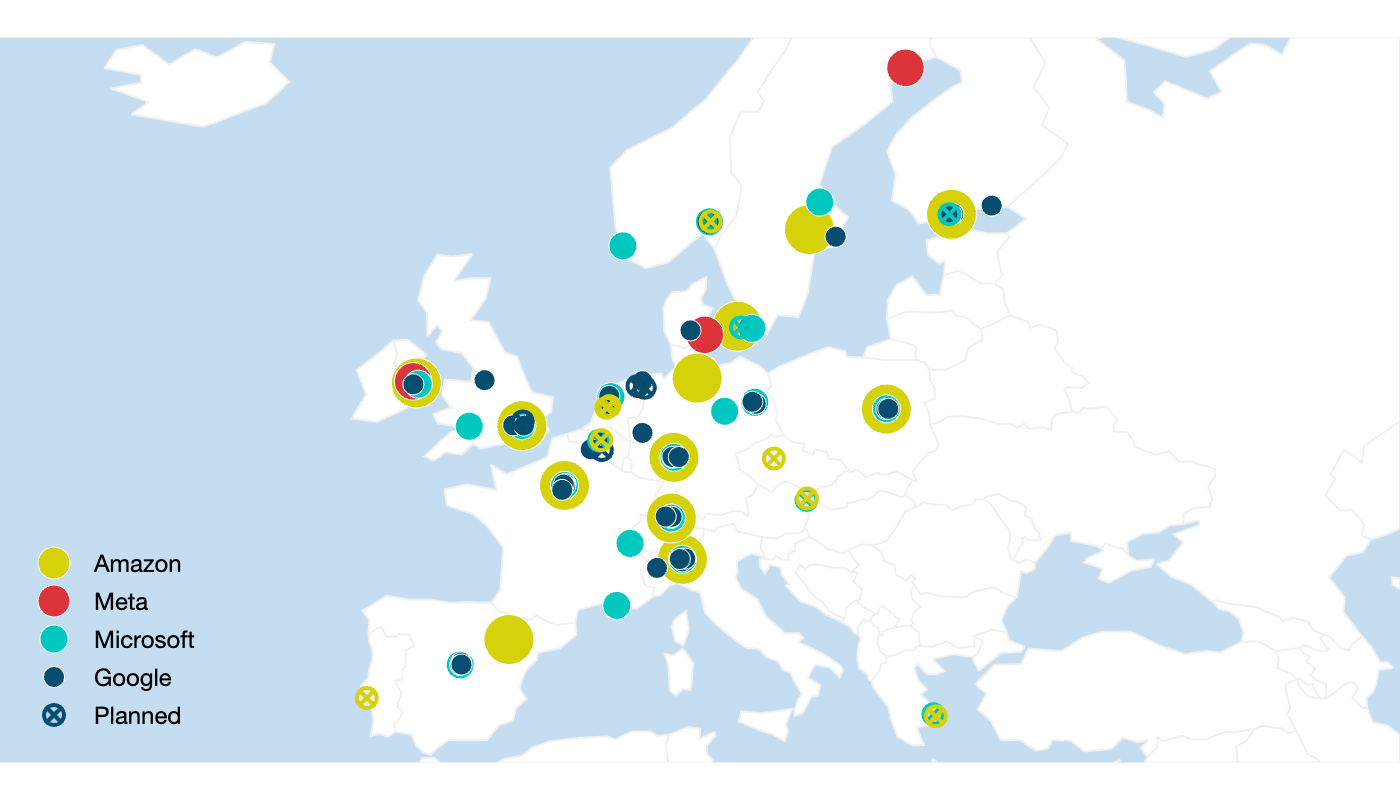
But it’s truly the content providers leading the surge in bandwidth demand. Nearly 80% of all international bandwidth deployed in Europe is utilized by content providers, including major cloud service providers. In addition to the 57 live cloud regions in Europe, operators are planning to launch 12 new cloud regions starting in 2026.
Select Proprietary and Cloud Region Data Center Locations in Europe
.png?width=1400&height=800&name=unnamed%20(1).png)
Demand is increasingly driven by intense needs to connect data centers. And with global investment in AI and GPU infrastructure soaring, Europe is keen to stay in the AI race with a focus on sovereignty, ethical development, and strategic implementation. To keep pace with demand on all fronts, larger customers are not only shifting to 400 Gbps, but to Nx400 Gbps and dark fiber.
A Deeper Look at Capacity Price Decline
Growing demand spurs continued investment in network infrastructure, which can include fiber overbuilds, diverse path construction, or infrastructure expansion. And generally speaking, when more capacity or supply becomes available, this leads to lower unit costs, and ultimately, lower prices for customers. So it’s no surprise that long term price erosion remains the norm. But competition and regional differences create nuanced dynamics on individual routes, though. Let’s take a closer look below at price points from TeleGeography’s Wavelengths Pricing Database.
Weighted Median 100 Gbps Wavelength Prices & CAGR Price Decline on European Routes
.png?width=1100&height=660&name=unnamed%20(2).png)
Core FLAP routes have immense capacity requirements as they connect the largest business hubs in Europe, and they also see more competition. In Q3 2025, the 100 Gbps weighted median on Frankfurt-London was $1,150 with a modest decline of 8%, compounded annually over the past three years. This low price is also a reflection of new technologies, like ZR+ pluggable optics and hollowcore fiber, emerging within Europe’s hubs. Connectivity costs are often higher in Eastern Europe, as demonstrated by Frankfurt-Sofia's high weighted median price. More carriers are expanding outward to Sofia as it is proving to be a pivotal interconnection point between Central Europe, Central Asia, and the Middle East.
As bandwidth demand continues to increase, providers report that 400 Gbps wavelengths are beginning to take up a greater percentage of capacity sales across Europe. Price multiples between 100 Gbps and 400 Gbps services have fallen as a result. On the Frankfurt-London route, the weighted median 400 Gbps price was just 2.7 times more than the 100 Gbps price, for four times the capacity. But price multiples remain higher on subsea routes, such as London-New York at 3.8. There are additional infrastructure and equipment upgrade costs when transitioning to 400 Gbps, but the savings on install, cross connect charges, and power consumption can make up for that over time.
Navigating Intercontinental Challenges
Higher price multiples have not slowed down demand for greater bandwidths. Skyrocketing growth across the Atlantic has been due to new cables such as MAREA, Havfrue, Dunant, and Grace Hopper. These systems offer diversified landings on the European side spanning from Scandinavia down to Portugal, and provide greater resilience than in the past.
But it’s critical to consider that 93% of Trans-Atlantic capacity is deployed by content providers and is not readily available in the wholesale market. Recent conversations have hinted at a looming capacity crunch on the horizon. Understandably, our data shows that 100 Gbps erosion on London-New York slowed to just 2%, compounded annually over the past three years.
Moving eastward, the Europe-Asia route has struggled with capacity provisioning, largely due to ongoing geopolitical issues and submarine cable faults in the Red Sea. To make matters worse, there are indefinite delays on desperately needed new high-capacity cables. The combination of uncertain supply and high demand has caused carriers to hold prices stable or report sales on the higher end of the market range. As a result, the three year CAGR decline on Marseille-Singapore’s 100 Gbps weighted median price was a mere 2%. Fortunately, we’ve seen incredible investments bypassing the Red Sea terrestrially, whether through Saudi Arabia avoiding the chokepoint in the Red Sea, or north through Iraq and Turkey avoiding the Red Sea altogether. With or without cable faults, these alternative routes are especially crucial as hyperscalers are requiring as many as four or five diverse paths for resiliency. And even large enterprises are willing to pay more for this diversity.
Dark Fiber’s Illuminating Role in European Connectivity
The growing need for ultimate scalability and control is driving the increased visibility of dark fiber in Europe. Primarily adopted by hyperscalers, dark fiber is an unlit fiber optical cable that can be a savvy alternative to multiple 100 or 400 Gbps wavelengths for those requiring massive bandwidths. It offers maximum control, scalability, and security as it provides the highest level of physical separation from other users. However, this comes with significant drawbacks, including a high upfront cost for optical transmission equipment and the operational burden of network design, maintenance, and troubleshooting—all requiring in-house technical expertise.
Furthermore, dark fiber pricing is complex, varying significantly based on factors like route competition—with lower rates found on competitive Western European routes—geography, purchase volume, and even the customer's negotiation skill. Despite the appeal of dark fiber, some high-capacity customers still opt for lit capacity, as wavelengths remain competitive and inexpensive in Europe, offering buyers both cost efficiency and simplicity in management.
Ultimately, the shift to higher capacity services highlights the industry's dynamic energy and suggests an adaptable market poised for transformation, driven by relentless demand and a focus on diverse, resilient network paths.
Catch Up on Stacey's Capacity Europe Presentation
Watch below and get the slides here.
Get More of This Data
This is only a small sample of the data and analysis available in TeleGeography's research platforms. Get all the intelligence our telecom experts have access to when you subscribe.
Network Pricing Database
Subscribe to one module or as many as you need:
- Business Broadband
- Dedicated Internet Access
- Ethernet Over MPLS
- Ethernet VPN
- IP Transit
- Local Access
- MPLS VPN
- Network-as-a-Service (NaaS)
- SD-WAN
- Wavelengths

Stacey Parker
Stacey Parker is a Research Analyst at TeleGeography. Her research is focused on connectivity services and pricing in the European markets.